What started as a hobby and side hustle for many has now escalated into a major creator economy globally. Amidst all the content genres, one critical category is that of finance.
Today, the flow of information, especially related to finance, has surprisingly shifted from traditional sources to social media platforms like TikTok. While the intention of these tax influencers might be to educate and inform their followers about financial loopholes, this trend, in reality, has taken a dangerous turn.
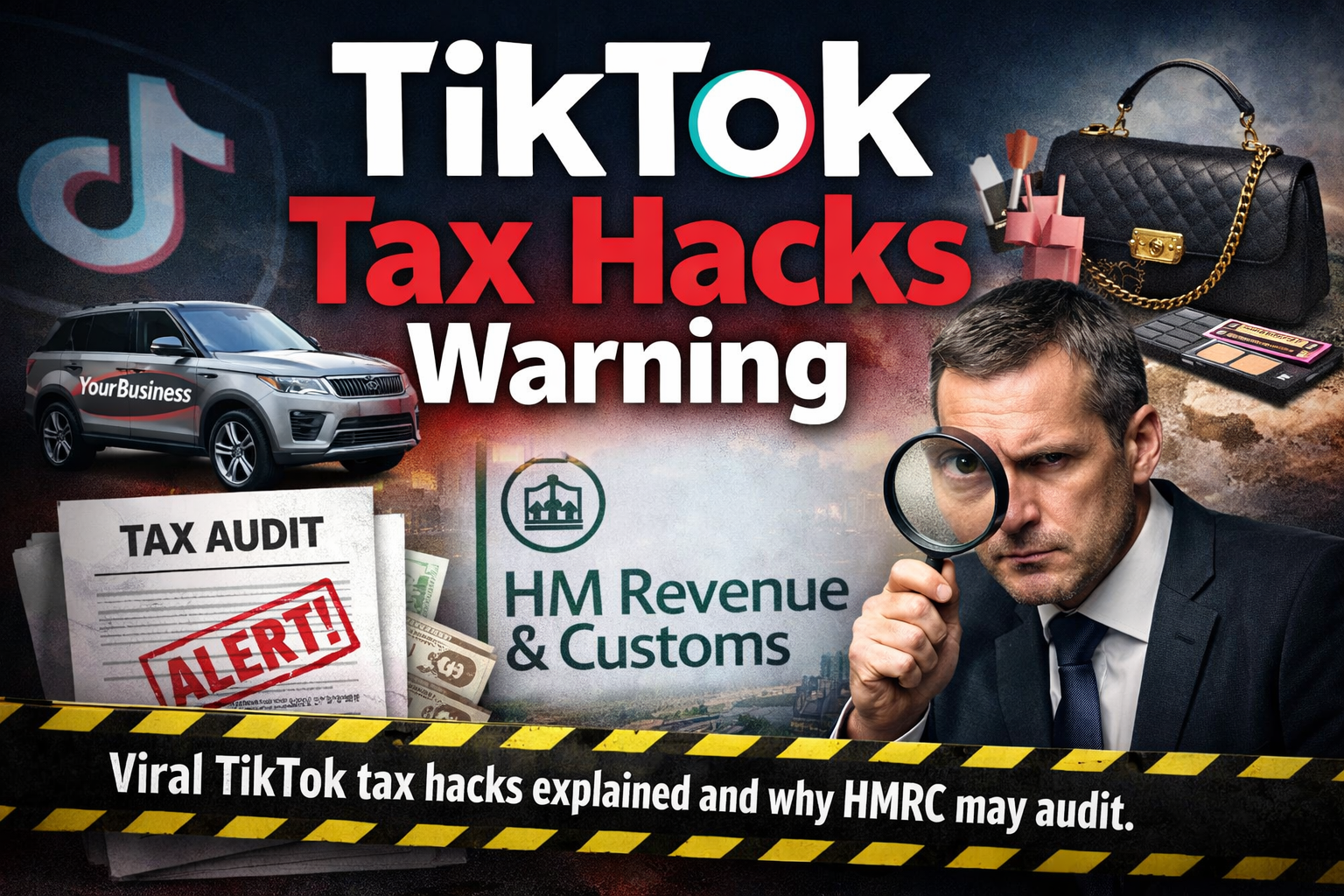
As a TikTok UK accountant, I have observed this viral financial advice content with excessive reach. But sadly, more often than not, what these videos present is completely wrong. It was only a matter of time until HM Revenue & Customs (HMRC) noticed it and took action. As a result, in 2024, HMRC officially launched targeted nudge campaigns for tax influencers. In 2026, they initiated AI-driven lifestyle audits to spot variations between reported income and visible spending.
Hence, if you, too, are tempted by these viral financial hacks, below are the five guaranteed red flags to identify them.
1. The “marketing expense” Range Rover
“Buy a luxury SUV, cover it in your business logo, and write off the whole purchase price and maintenance as a marketing expense since it acts as a ‘mobile billboard’.”
Whether it is a Range Rover or any luxury car, according to HMRC, for it to be considered a “van” or “commercial vehicle” for tax purposes, it must meet a specific payload criterion.
Even if you wrap the car with your personal branding, it still legally is a dual-purpose asset. How? Because you will be using that very car to accomplish your personal necessities. Due to a clear duality of purpose, it is impossible to reclaim the full costs as a business expense. You can only make a partial claim based on the degree of actual business mileage. Even then, if the car is owned by your limited company, you will be charged under the “Benefit in Kind” (BIK) category.
2. The “business uniform” designer wardrobe

“I’m a fashion influencer, so these Prada boots and the Chanel bag are ‘work clothes’. Since I am using them to create content, they are 100% tax-deductible.”
Citing from the famous tax case of Mallalieu v Drummond, the court ruled that even if a professional purchases specific clothes for work purposes, the items worn still provide the necessary warmth and decency that a person requires to sustain.
Clothing pieces are deductible only for:
- A branded uniform displaying a permanent, non-detachable logo.
- Protective gear, like steel-toed boots.
- A costume specifically for a performer, because a reasonable person would not wear them on the street.
Therefore, unless you are adorned in a hi-vis vest that has your branding, your OOTD (Outfit of the Day) is certainly a personal expense.
3. “Self-care” as a business deduction
“My face is my brand! For this reason, my botox, expensive spas, and frequent hair appointments are ‘business maintenance’ costs.”
Similar to the clothing rule, HMRC considers cosmetic procedures and general grooming as having a “duality of purpose.” Your face is not an accessory that you can take off and put on only when the camera is rolling.
While there have been rare exceptions, such as the Gemma Daniels case, where the performer was allowed to wear certain “stage” makeup, for the average creator, these are treated as private medical or personal care expenses. If you claim these glow-ups as a business cost, expect to receive an enquiry letter from the HMRC.
4. The “work from home” luxury renovations
“I constantly film videos in my new kitchen, so the £30,000 renovation costs are a ‘studio upgrade,’ where I can claim the VAT.”
Since the rollout of MTD for VAT, HMRC’s software has been efficiently identifying unusual VAT refund claims. A kitchen in a house is a domestic necessity, whether you use the space for filming or not.
While not wholly, you can claim a portion of household bills, like internet, heating, electricity, etc., depending on the area used and time spent for work purposes. Claiming a capital upgrade to your home as studio costs is a red flag. If you do so, HMRC might ask for floor plans and proof of exclusive business use of the home renovation.
5. The “gifts aren’t income” delusion
“The brand sent me a £2,000 watch as PR. Since there’s no direct payment in cash, I don’t have to report or pay tax on it.”
HMRC treats “PR gifts” (valued above £50) from brands in exchange for promotional services as “money’s worth.” The market value of that item must be reported as taxable income. Moreover, by 2026, every digital platform must share data with HMRC about creators’ earnings and brand collaborations. If you are making ‘PR hauls’ videos but reporting minimal income on your tax return, it will be flagged as a discrepancy.
Understanding the “wholly and exclusively” rule
To stay on the safe side, it is a necessity for every creator to know the golden rule of UK tax: The expense must be incurred “wholly and exclusively” for trade purposes. Here,
- Wholly refers to the amount. For example, if you use your phone 50% for business and 50% for personal needs, you can only claim half the bill.
- Exclusively refers to the intent. Say, you bought an item with a dual motive, such as a car for both family use and business. Here, it fails the exclusivity test, and the whole claim could be disallowed.
The overview
If you face enquiries from the HMRC, following advice from tax influencers is not a valid legal defense. Irrespective of your reason, they will decide your claims to be “deliberate and concealed”, which most of these hacks actually are, resulting in soaring penalties and interest on tax due.
Thus, as a TikTok UK accountant, my advice is that if a tax hack sounds too good to be true, ignore it. Because at the end of the day, the HMRC inspector will scrutinize you when the audit begins, not the influencer.