
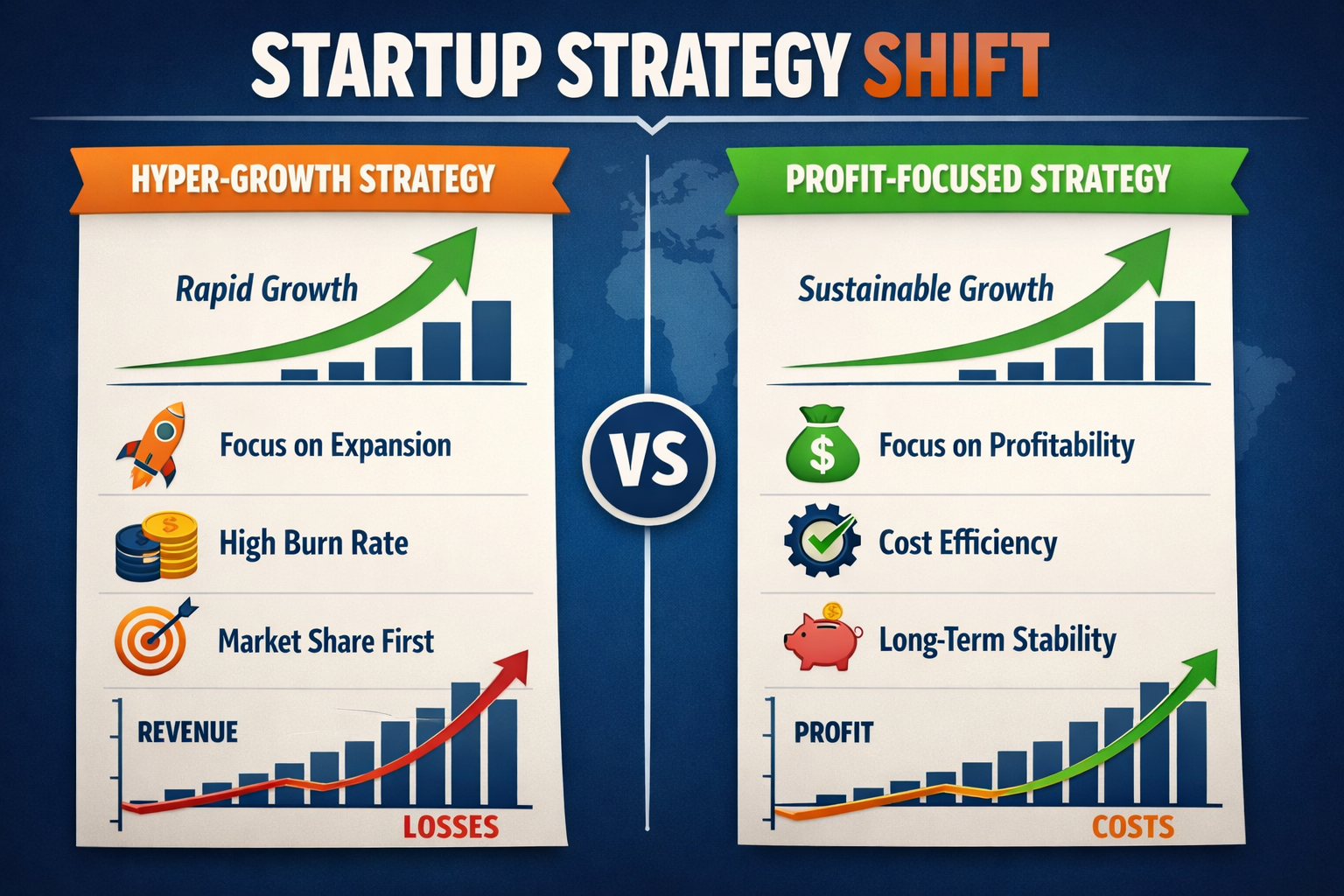
A significant change is occurring in the startup world. Over the past few years, the primary objective of startups was quite straightforward: become fast, go international, and get as many users as possible, at the cost of severe losses. This led to the hyper-growth startup era, where business organizations put more emphasis on size rather than profitability.
However, this is no longer the case. The new way of thinking has been necessitated by investors, market conditions and real-world failures. No longer do startups only get evaluated on the basis of growth but on the basis of profitability, sustainability and efficiency. It is the start of a startup culture of profits first.
The Rise and Fall of The Hyper-Growth Startup Model.
The hyper-growth model was popular at the time of easy access to venture capital and low interest rates. With huge funding, startups would scale fast and expand into new markets and acquire millions of users within a few years. They concentrated on aggressive marketing, intensive discounts and rampant expansion tactics.
Initially, this model appeared to be very successful. A number of companies achieved unicorn status in a short period of time. But behind the success, there was an underlying serious problem-most of these companies were not profitable. They were barely making ends meet due to the constant investment by investors.
As the world economic situation was changing, funding came to a halt. Investors began to have some rough questions on unit economics and actual profits. Due to this, numerous startups collapsed or had to close down their businesses. This was a clear indication that no growth can last without profit.
Principal Reasons in the Change.
- Favourable terms of easy funding are no more.
- Investors are now concentrating on actual business performance.
- The models of high cash burn are turning dangerous.
- Start ups are under pressure to be self-sustainable.
- Competition in the market requires efficiency and not expansion.
The Process of Shifting to Profit-First Thinking.
concentrate on Real Business Performance.
The startups have started to concentrate on genuine financial health rather than vanity metrics. In the past, firms would celebrate the number of downloads (app), user registrations and traffic. Nowadays, these figures are not sufficient. Shareholders would like to observe good profit margins, revenue stability and good cash flow.
It is altering the type of business model startups are developing to have more robust and realistic business models. All the decisions are now pegged on the financial performance rather than popularity and hype.
Controlled Growth and Lean Operations.
Innovative businesses are getting more conservative about expenditures. They do not venture into more than one market at a time but initially attempt to make a good market in one good market. The teams are maintained small and lean and there is no needless hiring.
The companies are also minimizing wastage on marketing and ensuring that they only invest in the marketing channel that will provide real returns. This lean methodology is useful to enable the startups to last longer and minimize the financial strain.
AI and Automation.

Artificial intelligence has been contributing immensely to this change. AI tools are being utilized by startups to automate customer support, enhance marketing approaches, and cut down on operational expenses.
Automation enables companies to accomplish more using a reduced number of employees, and this means a lot in terms of profitability. Another way that AI assists businesses to make smarter decisions is through the analysis of large quantities of data within a short timeframe.
Impact on Startup Ecosystem
The profit-first mentality has totally transformed the way startups are created and financed. Founders now will be more disciplined and realistic in terms of growth.
Investors, too, are more cautious. They like start ups that possess:
- Clear revenue models
- Controlled expenses
- Strong market demand
- Realistic scaling plans
Due to this reason, there is more selective funding, though more stable and sustainable.
Future of Startups
Startups will be about balance in the future. Business will expand, but not at all costs. The growth will be less, yet more stable and profitable.
We will witness additional startups that are centered on:
- Profitability at an early stage rather than survival at a later one.
- More intelligent utilization of technology such as AI.
- Small yet effective teams.
- Sustainable expansion strategies
- This new stage will make more robust and sustainable companies.
Conclusion
The hyper-growth startup phase contributed to creating some of the largest tech businesses in the world, yet it revealed its flaws. An endless unprofitable growth is not a model.
The world is now shifting towards a more balanced mode where speed is not so crucial as profit, efficiency, and sustainability. Only those that create actual value and not swift growth will survive this new era as startups.
FAQs
1. What was the hyper-growth start-up model?
It was a plan, in which startups were keen on rapid growth and increasing users without considering its profitability.
2. What is the reason behind the failure of hyper-growth startups?
The reason why many of them failed was that they were costly, poor on profits and they relied on external funding.
3. What is a profit first strategy?
It is a business strategy in which startups are interested in making profits and financial stability at initial stages.
4. Are the start ups growing rapidly today?
Yes, but now growth is more disciplined and correlated with profitability as opposed to unthought expansion.
5. What is AI doing to assist startups?
AI will assist in lowering the costs, automation, and efficiency, as well as assist in better decision-making.